
Spray foam insulation stops moisture and air leaks in Hickory, NC homes by expanding into cracks, gaps, and cavities to form a continuous sealed barrier that blocks both air movement and vapor diffusion. Hickory sits in a humid subtropical climate with roughly 46 to 49 inches of annual rainfall and average humidity levels between 65% and 77% during peak summer months. That combination of heat and moisture makes unsealed homes especially vulnerable to condensation, mold growth, and energy loss through air infiltration. Residential Spray Foam Solutions in Hickory, NC can address both problems simultaneously because spray foam insulates and air-seals in a single application, unlike traditional materials like fiberglass or cellulose that slow heat transfer but still allow air to pass through and around them.
Hickory’s climate classification as humid subtropical means homeowners deal with high outdoor humidity for much of the year. Temperatures swing from roughly 30°F in winter to 88°F in summer, and that wide range creates conditions where warm, moist indoor air meets cold exterior surfaces in winter, and hot, humid outdoor air pushes into wall cavities and crawl spaces in summer. See us on Google to review customer feedback when evaluating local insulation professionals for moisture and air-sealing work. Both scenarios lead to condensation inside the building envelope.
The EPA classifies the southern United States as “hot and wet,” noting that moisture problems and their solutions differ from one climate to another and that the types of weatherization for different climates lead to different problems and outcomes. In Hickory specifically, the even distribution of roughly 47 inches of annual rainfall means there is no dry season to let building cavities naturally dry out.
Uncontrolled air movement through the building envelope makes this worse. As the EPA explains, uncontrolled leaks introduce moisture, humidity, pollen, and dust inside framing systems and interior spaces, leading to future air quality and durability problems. Spray Foam Insulation Guide provides practical guidance on how proper spray foam application can help address these air-sealing and moisture-control concerns. When warm indoor air escapes through ceiling penetrations into a cold attic during winter, the moisture in that air condenses on framing and sheathing. In summer, the reverse happens when humid outdoor air is drawn into wall cavities through gaps around windows, doors, and foundation joints.
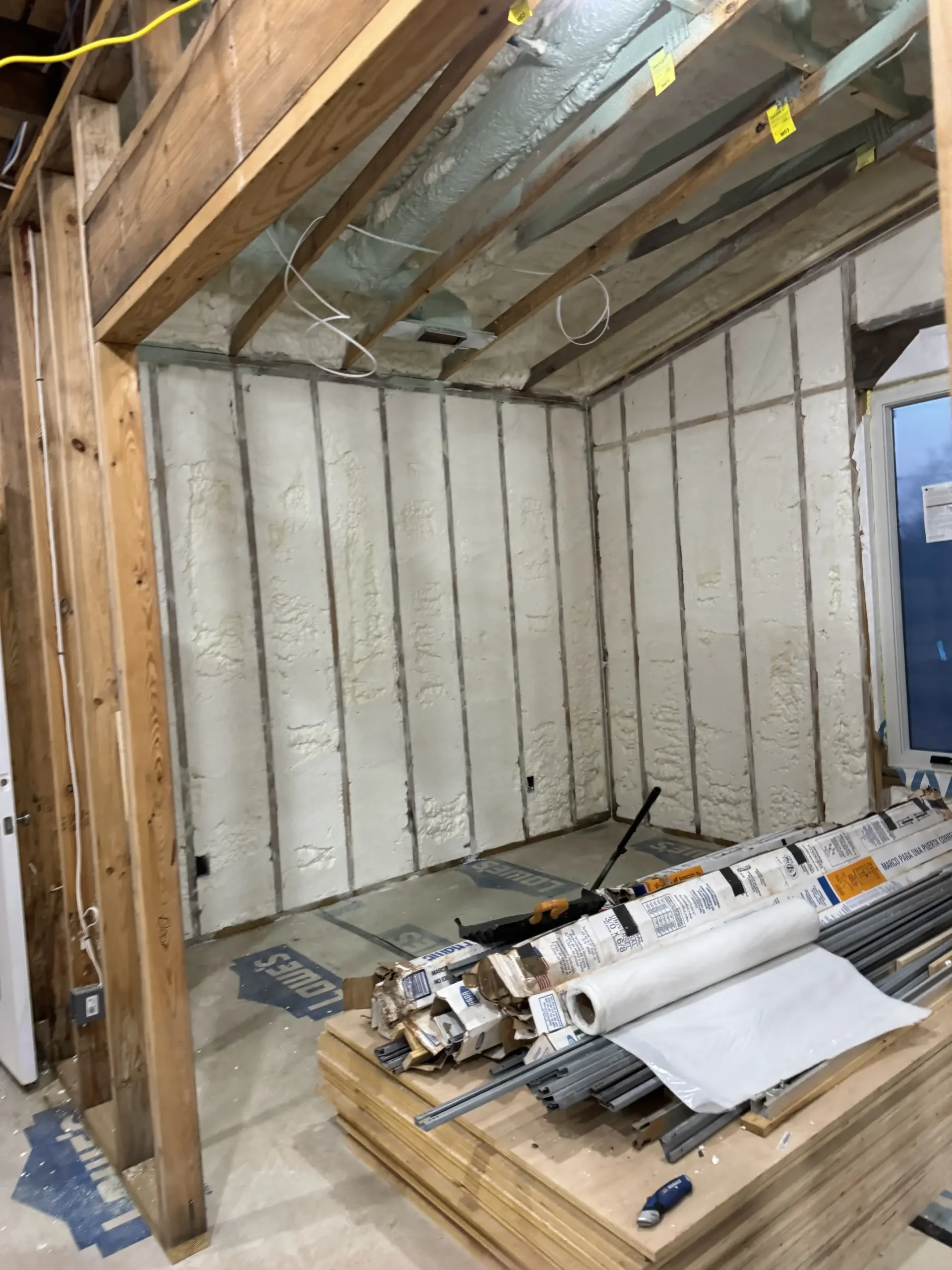
Spray foam is a two-component mixture of isocyanate and polyol resin that reacts at the tip of a spray gun and expands into a stiff, lightweight cellular structure. That expansion is what sets it apart from batt or blown insulation. The foam grows into and around irregular surfaces, plumbing penetrations, electrical runs, and framing gaps, creating a continuous seal rather than a fitted layer that leaves voids.
According to the Spray foam – Wikipedia entry, spray polyurethane foam’s most important attribute is its ability to air seal, creating a custom airtight envelope within the building structure. This blocks convective heat transfer, which is heat carried by air movement through gaps in the building envelope. By stopping air movement, spray foam eliminates the primary mechanism that transports moisture into and through wall cavities, attics, and crawl spaces.
The EPA notes that adding up all the leaks, holes, and gaps in a typical home’s envelope equals leaving a window open every day, year-round. Traditional insulation materials like fiberglass have an R-value of roughly R-3 to R-4 per inch, but they do not stop air from passing through and around them. Spray foam combines insulation with air sealing in a single step, which is why buildings treated with it can perform significantly better than those insulated with traditional materials alone.
Moisture moves through building assemblies in two ways: as bulk water (leaks) and as water vapor (diffusion and air-transported moisture). Spray foam addresses both.
Closed-cell spray foam is the stronger moisture barrier of the two types. According to Wikipedia, when closed-cell foam is installed at its minimum 50mm (approximately 2 inches) thickness, it functions as both a vapor barrier and an air barrier. Its sealed cell structure prevents water vapor from diffusing through the material, which means moisture in the indoor air cannot reach cold surfaces where it would condense. Spray Foam Insulation Services in Hickory, NC can help homeowners address these moisture-control requirements in crawl spaces and basements, where ground moisture is a constant concern and where the EPA recommends using vapor barriers over dirt floors and ensuring proper moisture control before any insulation work begins.
Open-cell spray foam has a lower density and a sponge-like structure with an R-value around 3.8 per inch. While thinner layers of open-cell foam are not effective as a vapor barrier because air and moisture can infiltrate through the open-cell structure, it does act as an air barrier when installed at 5.5 inches or more. This means it still stops the bulk of moisture that travels with air movement through gaps and penetrations.
The EPA’s guidance on moisture control recommends raising the temperature of cold surfaces where moisture condenses by using insulation, and notes that moisture problems differ by climate. In Hickory’s hot and humid environment, preventing humid outdoor air from entering wall and ceiling cavities is just as important as keeping indoor humidity in check. Spray foam applied to rim joists, crawl space walls, and attic floor assemblies creates the thermal and air barrier needed to keep cavity surfaces warm enough to prevent condensation.
The right type depends on the application, the area of the home, and the specific moisture risk at that location.
| Factor | Closed-Cell Foam | Open-Cell Foam |
|---|---|---|
| R-value per inch | 5.1 to 6.0 | Approximately 3.8 |
| Air barrier | Yes, at minimum thickness | Yes, at 5.5+ inches |
| Vapor barrier | Yes, at 2+ inches | No, in typical residential thicknesses |
| Moisture resistance | High, blocks vapor diffusion | Moderate, stops air-transported moisture only |
| Best applications in Hickory | Crawl spaces, basements, rim joists, exterior walls | Interior wall cavities, attics (vented assemblies), sound control |
| Density | Medium (2 lb/ft³) | Low (0.5 lb/ft³) |
For crawl spaces and basements in Hickory, where ground moisture and high humidity are constant concerns, closed-cell foam is generally the better choice because it provides both air and vapor barrier protection in one application. For interior wall cavities and vented attics where vapor diffusion is less of a concern but air sealing and sound control matter, open-cell foam is a practical option.
Tightening a building envelope is essential for energy efficiency and moisture control, but it must be paired with proper ventilation. The EPA’s guidance on energy, weatherization, and indoor air quality warns that air-tightening without ventilation can allow contaminants to build up to unhealthy levels and that moisture-laden air from everyday activities like cooking and showering can create conditions for mold growth without adequate air exchange.
The EPA’s recommendation for home additions applies equally to retrofit insulation projects: “build it tight, and ventilate right.” A well-sealed home with spray foam insulation and a properly sized mechanical ventilation system will have better indoor air quality than a leaky home because the air exchange is controlled and planned rather than driven by wind and temperature differences.
For Hickory homeowners upgrading with spray foam, this means ensuring that bathroom exhaust fans, kitchen range hoods, and whole-house ventilation systems are functioning correctly and meeting ASHRAE 62.2 residential ventilation standards. The ENERGY STAR seal and insulate guidance notes that proper air sealing combined with the right insulation improves humidity control and reduces the chance of ice dams, while also keeping out pollen, dust, and insects.
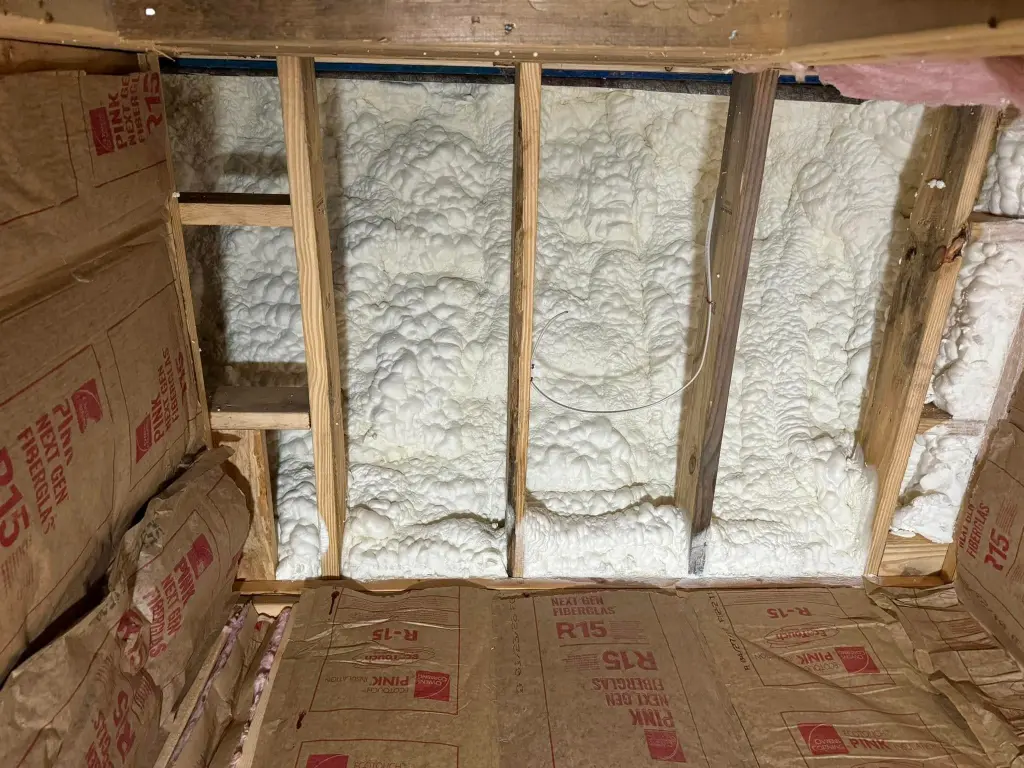
Based on the EPA’s remodeling and indoor air quality guidance, the most common and problematic air leakage and moisture entry points include:
Spray foam is effective in all of these locations because it adheres to irregular surfaces, expands to fill voids, and cures in place as a continuous material with no gaps or settling over time.
A few clear indicators separate a well-planned spray foam installation from a rushed one:
Spray Foam Pro helps Hickory, NC homeowners stop moisture intrusion and air leaks with professional spray foam insulation installed to the specific demands of our local climate. Our team evaluates every attic, crawl space, and wall assembly to recommend the right foam type and thickness for each area of your home, always with proper ventilation in mind.
Request a Quote | Schedule a Moisture Assessment
Call us at (910) 606-6247 or email [email protected] to get started. The right insulation strategy protects your home from moisture damage, lowers your energy bills, and keeps your indoor air comfortable year-round.
Yes. If applied in a damp space without addressing existing water intrusion, or if installed without considering vapor drive direction, spray foam can trap moisture and contribute to hidden damage. Proper assessment before installation prevents this.
Closed-cell spray foam installed at 2 inches or more acts as both an air barrier and a vapor barrier, so a separate polyethylene vapor barrier is not needed in those assemblies. Open-cell foam does not provide vapor barrier protection at standard residential thicknesses.
By sealing the building envelope, spray foam prevents humid outdoor air from infiltrating wall cavities and crawl spaces where it would condense on cooler surfaces. This reduces the moisture load inside the home and makes dehumidification and air conditioning more effective.
Air sealing alone does not cause problems, but it must be paired with adequate mechanical ventilation. The EPA recommends following ASHRAE 62.2 ventilation standards to ensure fresh air exchange after any air-tightening work.
Spray polyurethane foam is a thermoset material, meaning it cures into a permanent structure that does not degrade, settle, or shrink over time when properly installed. It maintains its air-sealing and insulating properties for the life of the building.