
If you’ve ever walked into a room in your house and felt a noticeable temperature difference from the rest of the home, you already know the frustration of poor insulation. Maybe your energy bills keep climbing despite adjusting the thermostat, or perhaps certain rooms just never feel comfortable no matter what you do. These are signs that your home’s thermal envelope isn’t doing its job, and it’s a problem that affects far more homes than most people realize.
Spray foam insulation is one of the most effective ways to solve these issues. Unlike traditional insulation materials that simply sit in place and slow down heat flow, spray foam expands on application to fill gaps, seal cracks, and create a continuous barrier against air and moisture. It’s a fundamentally different approach to insulating a building, and the results speak for themselves: tighter homes, lower energy consumption, and a level of comfort that fiberglass batts and blown-in cellulose simply can’t match when installed by experienced spray foam insulation professionals.
We’ve spent years working with spray foam in residential and commercial settings, and this guide pulls together everything we’ve learned. Whether you’re building a new home, renovating an older one, or just exploring your insulation options, you’ll find what you need here.
Here’s what we’ll cover: what spray foam is and how it works, the differences between open-cell and closed-cell foam, the specific benefits you can expect, where spray foam performs best in a home, the step-by-step installation process, common mistakes to avoid, and answers to the questions we hear most often from homeowners. Let’s get into it.
Spray foam insulation, technically known as spray polyurethane foam (SPF), is a chemical product created by mixing two liquid components that react rapidly on contact to form an expanding foam. According to Wikipedia’s overview of spray foam, these two components are commonly referred to as the “A” side and the “B” side. The A side contains isocyanates, while the B side contains a polyol resin blended with catalysts, flame retardants, blowing agents, and surfactants. When these two liquids meet at the tip of a spray gun, they react and expand up to 30 to 60 times their original liquid volume.
That expansion is what makes spray foam so effective. Traditional insulation materials like fiberglass or cellulose are cut or blown into cavities, but they don’t seal the gaps around them. Spray foam, on the other hand, flows into every crack and crevice before it hardens, creating a custom-fit barrier that adheres directly to the substrate.
Spray polyurethane foam was first developed in the late 1930s when Otto Bayer invented polyurethane, and it began seeing use as building insulation in the late 1970s. Since then, it has become one of the fastest-growing segments of the insulation industry. The global spray foam market was valued at approximately $2.34 billion in 2023 and is projected to reach $3.63 billion by 2030, reflecting growing demand for energy-efficient building solutions.
Expert Tip: Not all spray foam is created equal. The quality of the installation depends heavily on the installer’s skill and the equipment used. A poor application can leave voids, cause off-gassing issues, or fail to achieve the rated R-value. Always work with experienced, certified professionals.
To understand why spray foam outperforms other insulation types, it helps to understand how heat moves through a building. The U.S. Department of Energy explains that heat transfer occurs through three mechanisms: conduction (heat moving through solid materials), convection (heat carried by air movement), and radiation (heat traveling in straight lines and warming solid objects in its path).
Most insulation materials address conduction by trapping still air within their structure. Fiberglass, for instance, relies on a matrix of glass fibers to slow conductive heat flow. Spray foam does this too, but it goes further by also blocking convective heat transfer. When spray foam expands and seals a cavity, it eliminates the air movement that carries heat in and out of your home. That air-sealing capability is what sets it apart.
Here’s why that matters: the EPA’s Energy Star program has found that air leakage accounts for 25% to 40% of the energy used for heating and cooling in a typical home. No amount of fiberglass or cellulose insulation will stop that air leakage on its own. Spray foam addresses both problems simultaneously, insulation and air sealing, in a single application.
The performance of insulation is measured in R-value, which indicates resistance to heat flow. Higher R-values mean better insulating effectiveness. Spray foam delivers impressive R-values per inch of thickness, especially the closed-cell variety, which means you can achieve high performance even in spaces with limited depth.
Not all spray foam is the same. There are two primary types used in residential and commercial applications, and choosing the right one depends on where it’s being installed, what performance characteristics you need, and your budget. The Spray Polyurethane Foam Alliance provides a helpful comparison of both types.
Open-cell foam, sometimes called half-pound foam, is a lower-density product with a spongy texture. The cells in the foam are not completely closed, which means air fills the open spaces within the material. This gives open-cell foam a few distinctive characteristics:
Open-cell foam expands significantly during application, making it great for filling large cavities like wall studs and attic spaces. It’s generally recommended for indoor, above-grade applications where moisture exposure isn’t a primary concern.
Closed-cell foam, also called two-pound foam, is a denser, rigid product where every cell is sealed shut. This structure gives it several advantages:
Closed-cell foam is the go-to choice for areas prone to moisture, such as basements, crawl spaces, and exterior applications. It’s also the better option when you need maximum R-value in a limited depth, like in cathedral ceilings or retrofit wall cavities.
| Feature | Open-Cell | Closed-Cell |
|---|---|---|
| R-Value per Inch | ~3.5 to 3.8 | ~6.0 to 7.5 |
| Density | 0.4 to 1.2 lbs/ft³ | 1.75 to 2.25 lbs/ft³ |
| Air Barrier | Yes (at full wall thickness) | Yes |
| Vapor Barrier | No | Yes (at 50mm+ thickness) |
| Moisture Resistance | Lower | Higher |
| Sound Absorption | Excellent | Good |
| Structural Strength | Lower | Higher |
| Best Applications | Interior walls, attics | Basements, crawl spaces, exterior walls |
| Relative Cost | Lower | Higher |
Key Takeaway: Choose open-cell foam for interior applications where sound dampening and cost savings matter most. Choose closed-cell foam for moisture-prone areas, tight spaces, or when you need the highest possible R-value per inch.
Spray foam insulation offers a range of benefits that go well beyond what traditional insulation materials can provide. Here’s a closer look at what makes it such a strong choice.
The most commonly cited benefit of spray foam is its impact on energy consumption. Because spray foam creates an airtight seal, it dramatically reduces the air leakage that wastes energy in most homes, according to the Why Spray Foam initiative. HVAC sizing can be reduced by as much as 35% with properly installed spray foam, without any loss of comfort. That means your heating and cooling systems don’t have to work as hard, which translates directly to lower energy bills.
The U.S. Department of Energy estimates that heating and cooling account for 50% to 70% of the energy used in the average American home. When you cut the air leakage that drives so much of that energy waste, the savings add up fast. EPA’s Energy Star program estimates that adding insulation and sealing air leaks can save homeowners up to 20% on monthly energy bills.
Unlike fiberglass batts or blown-in cellulose, spray foam doesn’t just sit in a cavity. It expands to fill gaps around wiring, plumbing, ductwork, and framing irregularities. This creates a continuous air barrier that stops drafts at their source. Common leak points like rim joists, attic hatches, plumbing penetrations, and electrical boxes are all sealed in a single pass.
Closed-cell spray foam acts as a vapor barrier when installed at sufficient thickness. This helps prevent condensation inside wall cavities, which can lead to mold, mildew, and wood rot. In basements and crawl spaces where moisture is a constant concern, this moisture-blocking capability is a major advantage.
Expert Tip: In mixed-humid climates, moisture management is just as important as temperature control. Don’t just look at R-value when comparing insulation options. Consider how the material handles vapor drive and whether it could trap moisture in your wall assembly.
Both open-cell and closed-cell foam absorb sound, but open-cell is particularly effective at reducing airborne noise transmission. Homeowners often notice a significant reduction in outside traffic noise, sounds between rooms, and general ambient noise after spray foam is installed in interior walls and ceilings.
Closed-cell spray foam adds rigidity to the building envelope. Because it bonds directly to framing and sheathing, it increases a wall’s resistance to wind and impact loads. In areas prone to severe weather, this added structural performance can be a meaningful benefit.
Properly installed spray foam insulation can last for the life of the building. Unlike fiberglass, which can settle over time and lose effectiveness, spray foam maintains its shape and performance indefinitely once cured. There’s no sagging, no settling, and no need to re-insulate later.
Spray foam is versatile enough to be used throughout a building, but certain areas benefit more than others. Here’s a breakdown of the most common applications.
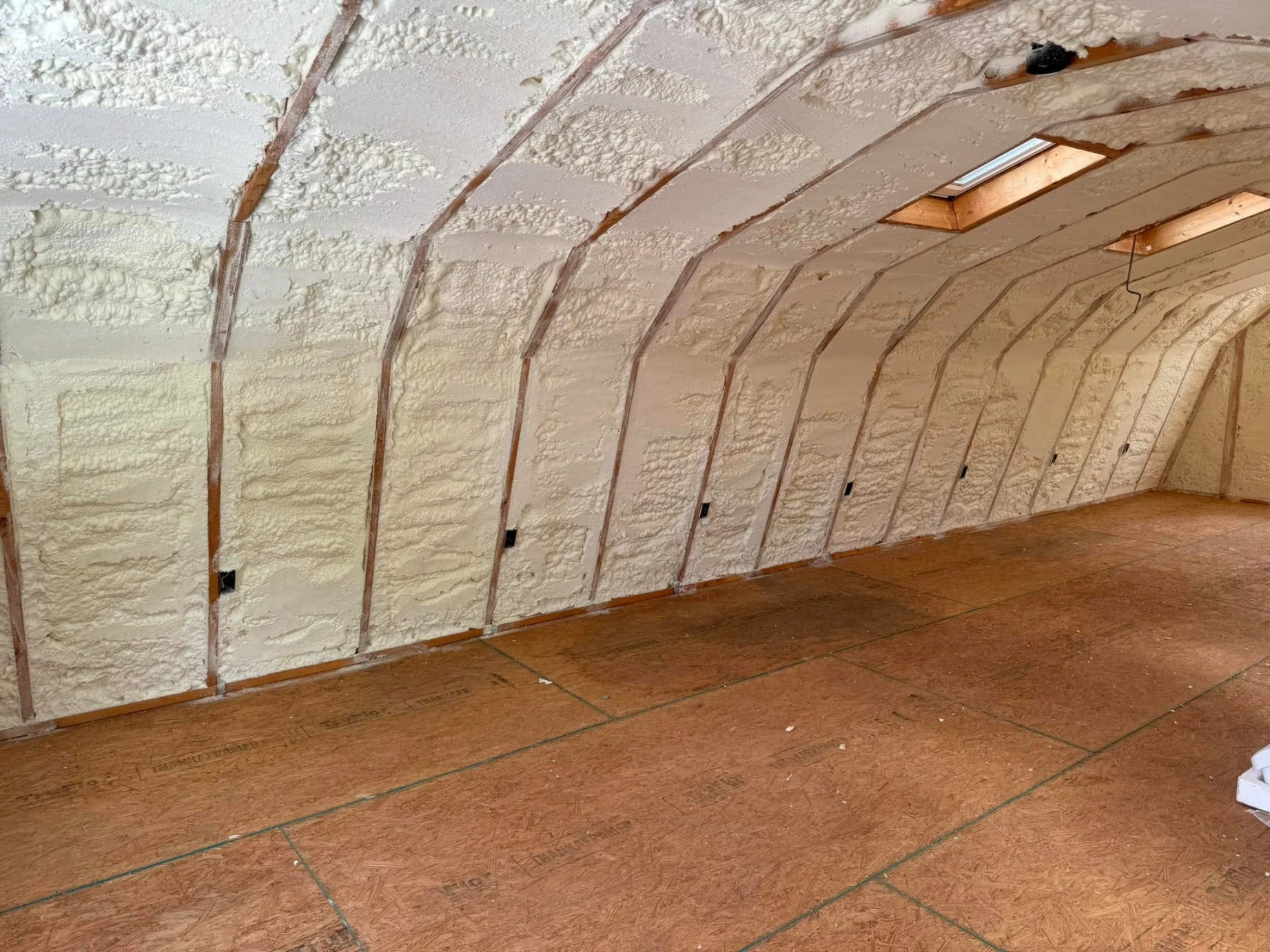
Attics are one of the biggest sources of energy loss in any home. In a traditional vented attic, temperatures can soar above 130°F in the summer and drop well below freezing in the winter. Spray foam can be applied in two ways: on the attic floor to insulate the living space below, or on the underside of the roof deck to create an unvented, conditioned attic. The second approach, sometimes called a cathedralized attic, is increasingly popular because it keeps HVAC equipment and ductwork inside the conditioned envelope.
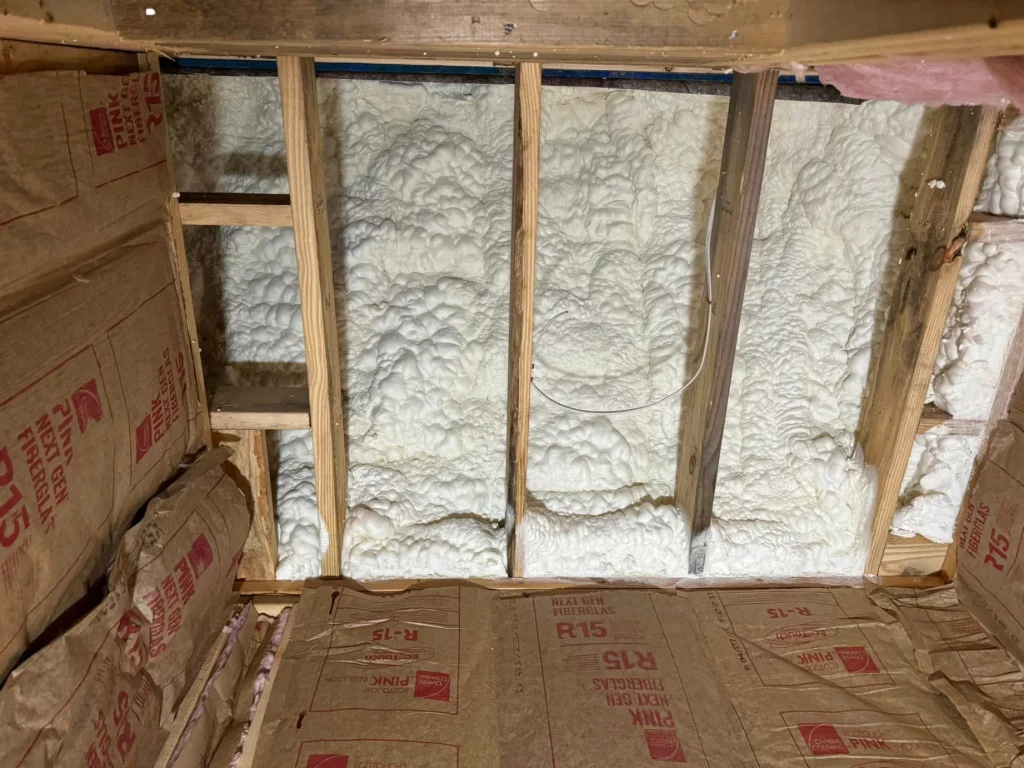
Spray foam excels in wall applications because it fills every gap and eliminates the thermal bridging that occurs through studs. In new construction, foam is sprayed directly into open wall cavities before drywall is hung. In existing homes, it can be injected into wall cavities through small access holes.
Below-grade spaces present unique challenges: moisture, temperature differentials, and limited access. Closed-cell spray foam is the top choice here because it provides both thermal insulation and a vapor barrier. Applying foam to basement walls or crawl space perimeter walls can transform these spaces from cold, damp problem areas into dry, conditioned parts of the home.
The rim joist, where the floor framing meets the foundation wall, is one of the most notorious air leakage points in any home. It’s also notoriously difficult to insulate with traditional materials. Spray foam is ideal for this application because it seals all the gaps between the sill plate, rim joist, and subfloor in one step.
Cathedral ceilings have limited space for insulation between the drywall and the roof deck. Closed-cell foam’s high R-value per inch makes it the clear choice here, delivering excellent thermal performance in a thin profile.
[Image: Cross-section diagram showing spray foam applied in multiple areas of a home: attic, walls, crawl space, and rim joist]
| Application | Recommended Foam Type | Key Benefit |
|---|---|---|
| Attic (vented) | Open-cell or closed-cell | Air sealing, reduced energy loss |
| Attic (cathedralized) | Closed-cell | Bring the attic into a conditioned space |
| Exterior walls | Open-cell or closed-cell | Eliminates thermal bridging, air sealing |
| Basement walls | Closed-cell | Moisture resistance, vapor barrier |
| Crawl space walls | Closed-cell | Moisture control, air sealing |
| Rim joists | Closed-cell | Seals the major air leakage point |
| Cathedral ceilings | Closed-cell | High R-value in limited depth |
| Interior walls (sound) | Open-cell | Superior sound absorption |
Understanding what happens during a spray foam installation helps you know what to expect and how to prepare. Here’s a step-by-step walkthrough of a typical professional installation.
Before any foam is sprayed, our team evaluates the building to determine which type of foam is appropriate, how much material is needed, and whether any existing insulation needs to be removed. This step also involves identifying moisture issues, air leakage points, and any structural concerns that could affect the installation.
The work area needs to be prepped properly. This means removing or protecting any items that could be damaged by overspray, ensuring adequate ventilation, and setting up the equipment. The spray rig, which houses the two chemical components and the heating/mixing system, is typically parked outside and connected to the application area via long hoses.
The installer wears full personal protective equipment, including a respirator, protective suit, and gloves. The two chemical components are heated and pressurized in the spray rig, then mixed at the spray gun as they’re applied. The foam begins expanding within seconds of hitting the target surface. The installer applies the foam in passes, building up to the desired thickness.
Once the foam has fully expanded and cured (which can take anywhere from a few minutes to several hours, depending on the type of foam and environmental conditions), any excess material is trimmed flush with the framing. The area is then cleaned up and made ready for the next phase of construction, whether that’s hanging drywall or covering the foam with an appropriate thermal barrier.
A thorough inspection ensures that all areas have been properly covered, the foam has achieved the correct thickness, and there are no voids or gaps. In new construction, this may involve third-party verification to meet building code or Energy Star requirements.
Expert Tip: Temperature and humidity during installation matter more than most people think. Spray foam needs a minimum substrate temperature to cure properly, and excessive humidity can interfere with adhesion. A quality installer will monitor conditions and adjust accordingly.
It’s worth noting that during the installation process, the chemicals used to create spray foam can be irritating to the eyes, skin, and respiratory system. Occupants and pets must vacate the area during application and for a specified period afterward while the foam cures and off-gases. Once fully cured, spray foam is inert and non-toxic. Professional installers follow strict safety protocols, including ventilation requirements and re-entry timelines, to protect everyone involved.
Spray foam is a high-performance product, but like any building material, it can underperform if it’s not installed correctly. Here are some of the most common issues we see and how to prevent them.
If the substrate is too cold, too wet, or covered in dust and debris, the foam may not bond properly. This leads to delamination, where the foam separates from the surface over time. The fix is straightforward: proper surface preparation and environmental controls before application.
Spray foam needs to be applied at the correct thickness to achieve its rated performance. Too thin, and you won’t get the R-value or air-sealing performance you paid for. Too thick, and you waste material. Experienced installers use depth gauges and visual checks to ensure consistent coverage.
Rushing through an installation or spraying at the wrong angle can leave voids behind framing members, in corners, or around obstructions. These gaps undermine the continuous air barrier that makes spray foam so effective. A careful, methodical application followed by a thorough inspection prevents this problem.
If spray foam is applied over a damp substrate or in an area where moisture is actively infiltrating, it can trap that moisture against structural components, potentially leading to rot. Any moisture issues should be resolved before foam is installed.
The two chemical components must be mixed at the correct ratio and temperature. Off-ratio mixing can result in foam that doesn’t expand properly, has reduced R-value, or fails to cure completely. This is one of the biggest risks with DIY spray foam kits and a primary reason professional installation is so important.
Expert Tip: If you’re ever unsure about the quality of a spray foam installation, request a thermal imaging scan. An infrared camera can reveal voids, thin spots, and areas where the foam didn’t adhere properly, all without removing any drywall or finishes.
To really understand spray foam’s value, it helps to see it side-by-side with traditional insulation options.
| Comparison Factor | Spray Foam (Closed-Cell) | Fiberglass Batts | Blown-In Cellulose |
|---|---|---|---|
| R-Value per Inch | 6.0 to 7.5 | 3.0 to 4.0 | 3.0 to 3.8 |
| Air Sealing | Yes | No | Minimal |
| Moisture Resistance | Yes (closed-cell) | No | No |
| Settling Over Time | No | Yes (some) | Yes (over time) |
| Fills Gaps/Voids | Yes | No (requires precise cutting) | Partially |
| Lifespan | Life of building | 15 to 30 years | 20 to 30 years |
| Sound Dampening | Good | Good | Good |
| Structural Benefit | Yes | No | No |
The numbers tell the story. Spray foam delivers higher R-values, better air sealing, longer lifespan, and added structural performance. The trade-off is a higher upfront cost. But when you factor in energy savings over the life of the building, spray foam often proves to be the more economical choice over time.
Spray foam insulation typically costs more upfront than traditional materials. That’s a fact. But looking only at the initial price misses the bigger picture.
Consider the following factors when evaluating ROI:
Energy savings. If spray foam reduces your heating and cooling costs by even 20%, those savings compound month after month, year after year. Over a 10- or 20-year period, the total savings can far exceed the additional upfront cost.
HVAC savings. Because spray foam reduces the heating and cooling load, you may be able to install smaller, less expensive HVAC equipment. That can offset a meaningful portion of the insulation cost, especially in new construction.
Reduced maintenance. Traditional insulation can settle, sag, or become damaged by moisture. Spray foam doesn’t. Once it’s in place, it performs consistently for decades.
Property value. Homes with spray foam insulation are increasingly attractive to buyers who value energy efficiency and low operating costs. This can translate to higher resale values.
Tax credits and incentives. Depending on where you live and current federal programs, spray foam insulation may qualify for tax credits that further reduce the effective cost.
Key Takeaway: Don’t evaluate spray foam insulation based on upfront cost alone. Consider the lifetime energy savings, HVAC equipment savings, reduced maintenance, and potential tax incentives. For most homeowners, spray foam pays for itself within 5 to 10 years and continues delivering savings for the life of the building.
By now, you should have a clear picture of what spray foam insulation is, how it works, and why it outperforms traditional insulation in so many ways. The key takeaways are straightforward: spray foam provides superior air sealing, higher R-values per inch, moisture resistance, and a lifespan that matches your building’s lifetime. Whether you choose open-cell for sound dampening and cost efficiency or closed-cell for maximum thermal performance and moisture protection, you’re investing in a material that delivers measurable, long-lasting results.
The installation process matters as much as the material itself. Surface preparation, environmental conditions, correct mixing ratios, and consistent application thickness all determine whether your spray foam achieves its rated performance. That’s why professional installation by experienced, certified applicators is so important.
Use this guide as your reference as you plan your project. Evaluate your home’s specific needs, consider the climate zone you live in, and choose the foam type that matches your application. And when you’re ready to move forward, don’t hesitate to reach out for expert guidance.
Choosing the right insulation for your home is a decision that affects your comfort, energy costs, and property value for decades. If you have questions about spray foam insulation or want a professional assessment of your home’s specific needs, we’re here to help. Contact Spray Foam Pro at (910) 606-6247 or email us at [email protected] to schedule a consultation. Our team will evaluate your property, explain your options, and help you make the best choice for your situation.
Once fully cured, spray foam insulation is inert and non-toxic. During installation, the chemicals do produce vapors that can be irritating, so occupants and pets must leave the area during application and for a period afterward. Professional installers follow strict safety protocols and will advise you on when it’s safe to re-enter the space.
When properly installed, spray foam insulation lasts for the life of the building. It doesn’t settle, sag, or degrade over time like fiberglass or cellulose. You should never need to replace it.
Yes. While it’s easiest to install during new construction, spray foam can be retrofitted into existing homes. Walls can be insulated by injecting foam through small access holes, and attics, basements, and crawl spaces are relatively straightforward to access for retrofit applications.
Spray foam itself does not serve as a food source for pests or insects. In fact, because it seals gaps and cracks, it can help prevent pests from entering your home through those pathways. However, if an access point exists elsewhere, foam won’t stop pests from finding it.
Spray foam sealant, the kind you find at hardware stores in aerosol cans, is a one-component product designed for small gaps around windows, doors, and other penetrations. Professional spray foam insulation is a two-component system applied with specialized equipment that delivers dramatically higher performance, consistent quality, and proper coverage. They’re fundamentally different products for different purposes.
Yes, in many cases. Ice dams form when warm air escapes into the attic and melts snow on the roof, which then refreezes at the edges. By air-sealing the attic and insulating the roof deck with spray foam, you eliminate the warm air leakage that causes ice dams in the first place.