
If your home has cold floors, a musty odor, or unusually high energy bills, the problem often starts right beneath your feet. Many homeowners in our area find that their crawl space is the hidden source of these issues. As a professional Crawl Space Insulation Contractor in Troy, NC, Spray Foam Pro knows that these problems aren't just minor inconveniences; they are signs that your home’s thermal envelope is failing. To fix this, you need a strategy that goes beyond simply adding fiberglass and hoping for the best. You need an approach that addresses moisture control, air sealing, and insulation in a way that respects the specific demands of our North Carolina climate.
Troy, NC, sits in a humid subtropical climate where high humidity and seasonal temperature shifts create a challenging environment for building foundations. According to the National Oceanic and Atmospheric Administration, our region receives significant annual precipitation, keeping soil and air moisture levels consistently high year-round. When this moisture-heavy air enters a vented crawl space, it frequently reaches its dew point, causing condensation to accumulate on cool wooden floor joists and insulation.
This constant wetting-and-drying cycle is why traditional building methods often fail in our area. The heavy clay soils common in the Piedmont region hold water for extended periods, meaning that even on dry days, moisture is constantly evaporating upward into your crawl space. When your crawl space isn't properly sealed, this damp air travels upward into your living space, leading to mold growth, wood rot, and a home that feels drafty in the winter and humid in the summer.
For decades, building codes required crawl spaces to be vented to allow airflow. The theory was that moving air would dry out the space, but in a humid climate like ours, the opposite happens. Instead of drying the crawl space, vents invite warm, damp outdoor air inside during the summer.
When that hot, humid air hits the cool surfaces under your home, it condenses. This turns your crawl space into a breeding ground for mold and pests. We often see older homes with fiberglass insulation that has absorbed this moisture, turned black, and eventually fallen off the floor joists. At that point, the insulation isn't just failing to keep your home warm; it is actually holding moisture against your subfloor and promoting decay.
An uninsulated or improperly sealed crawl space works against your HVAC system. This phenomenon, known as the "stack effect," occurs when air enters through your crawl space and rises through your home, escaping out of the attic.
When your crawl space is unsealed, your heater or air conditioner has to work significantly harder to maintain a comfortable temperature because it is constantly fighting the air being pulled up from beneath your house. By air sealing and insulating the crawl space, we can break this cycle. You will likely notice that your floors feel less cold during the winter and your indoor humidity levels become much easier to manage, which is a major factor in home comfort during North Carolina summers.
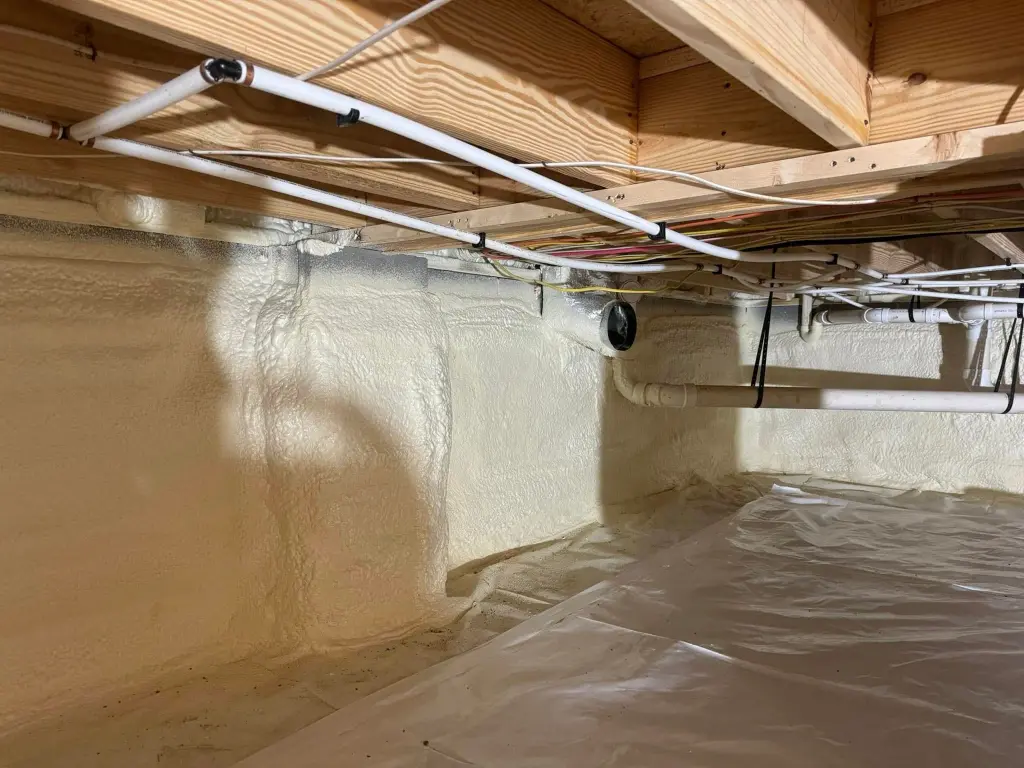
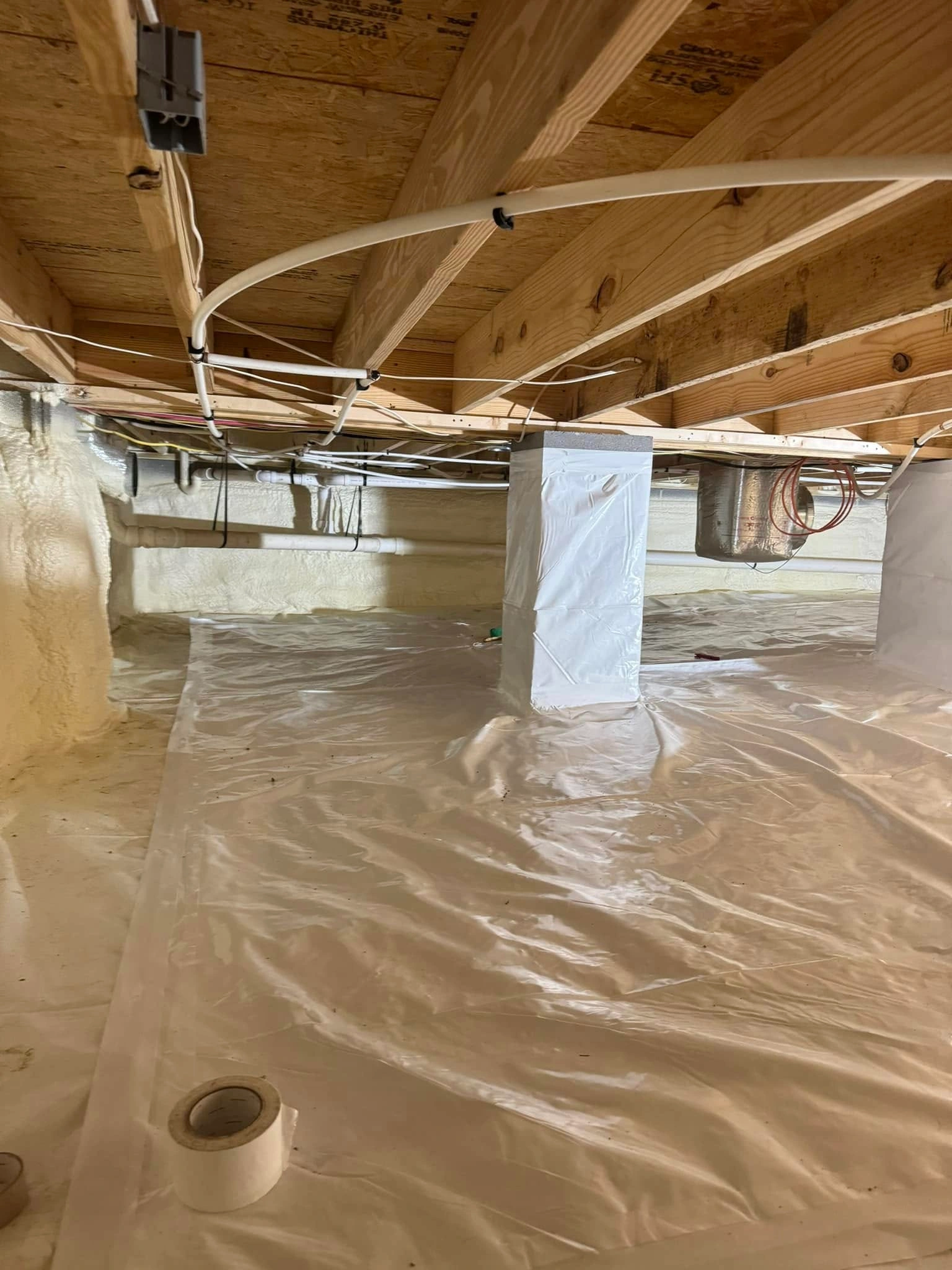
The most effective way to protect your home is to transition from a vented, damp crawl space to a sealed, conditioned one. This process involves closing the vents, installing a high-quality vapor barrier, and insulating the foundation walls rather than the floor above.
For this application, we typically prioritize closed-cell spray foam insulation. Unlike fiberglass batts, which act like a sponge, closed-cell spray foam provides a high R-value per inch and serves as a vapor retarder itself. The U.S. Department of Energy notes that proper air sealing is a prerequisite for insulation effectiveness, and spray foam excels at creating that airtight barrier in complex crawl space environments.
We perform every project according to the North Carolina Residential Code, which includes specific requirements for crawl space construction. One of the most important rules is the maintenance of a 3-inch inspection gap between the top of the insulation and the wooden sill plate.
This gap is mandatory because it allows for visual termite inspections. A contractor who skips this step is not only violating state code but is also putting your home at risk for undetected pest damage. Our team ensures that all vapor barriers are properly lapped, sealed at the seams, and attached to the foundation walls. This prevents ground moisture from migrating into the crawl space air, protecting the structural integrity of your floor system.
If you are tired of dealing with uncomfortable floors and high energy bills, it is time to look at what is happening under your house. We specialize in identifying the moisture sources and air leaks that are draining your home’s efficiency. Contact Spray Foam Pro today at (910) 606-6247 or email us at [email protected] to schedule an inspection. We can help you determine the best path forward to protect your investment and improve your home’s comfort.
Yes. Musty odors are usually caused by mold or mildew thriving on high humidity. By sealing the vents and installing a proper vapor barrier, we remove the moisture source that mold needs to grow.
In many cases, a low-maintenance, commercial-grade crawl space dehumidifier is the final piece of the puzzle. While spray foam stops the moisture from entering through the walls, a dehumidifier manages the remaining humidity levels to ensure the space stays dry year-round.
Adding more fiberglass to a vented crawl space in North Carolina usually makes the problem worse. The added material simply gives moisture more surface area to cling to, which can speed up the rate of wood rot and mold development.
The cost of encapsulation varies based on the size of your crawl space, the current condition of the foundation, and the amount of prep work needed, such as clearing out debris or old, wet insulation.
For a standard crawl space in Troy, we can typically complete the air sealing and insulation process in one to two days. However, the timeline depends on the accessibility of the crawl space and whether any moisture-damaged materials, like old insulation or debris, need to be removed before we begin the installation.