
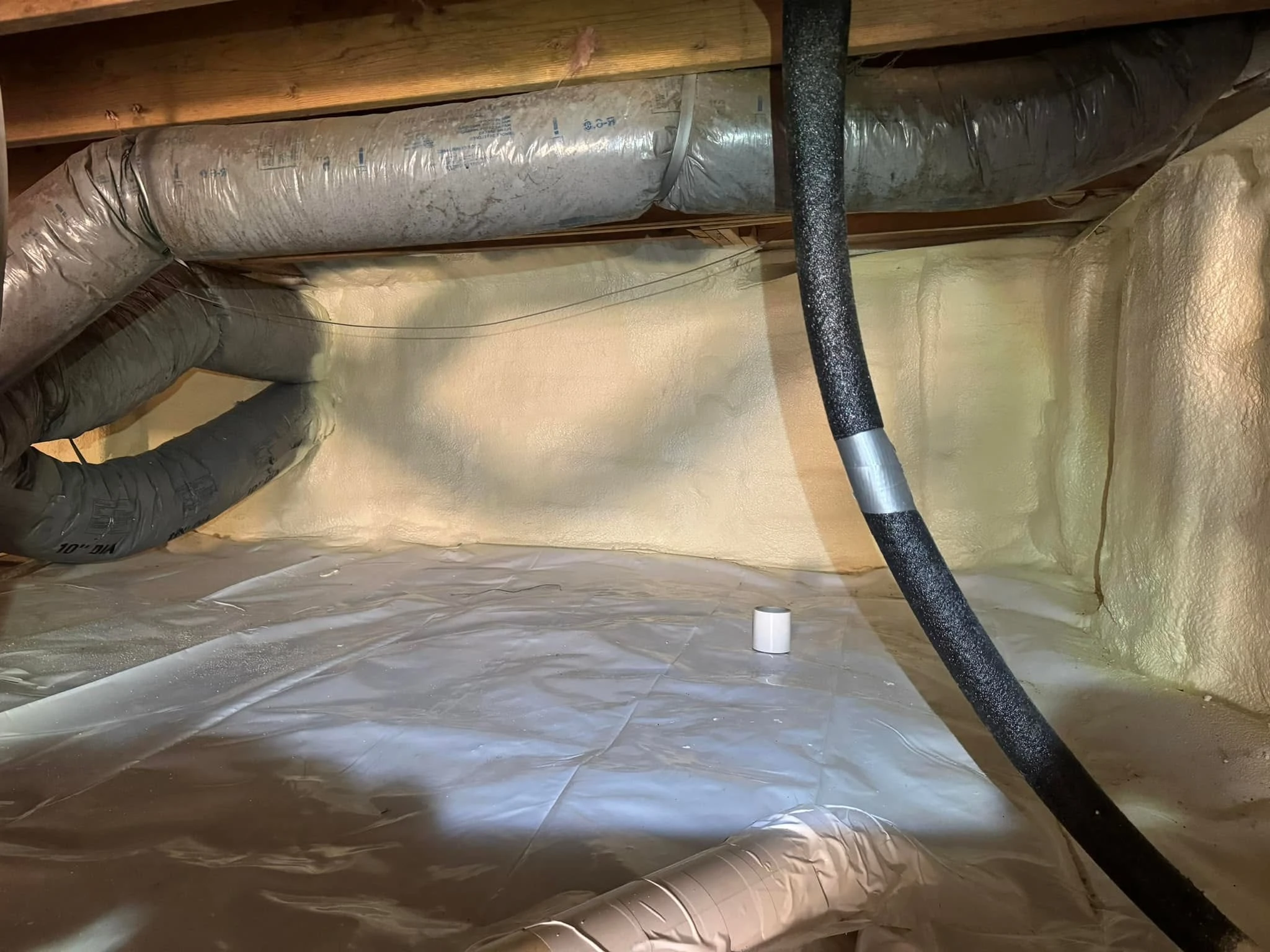
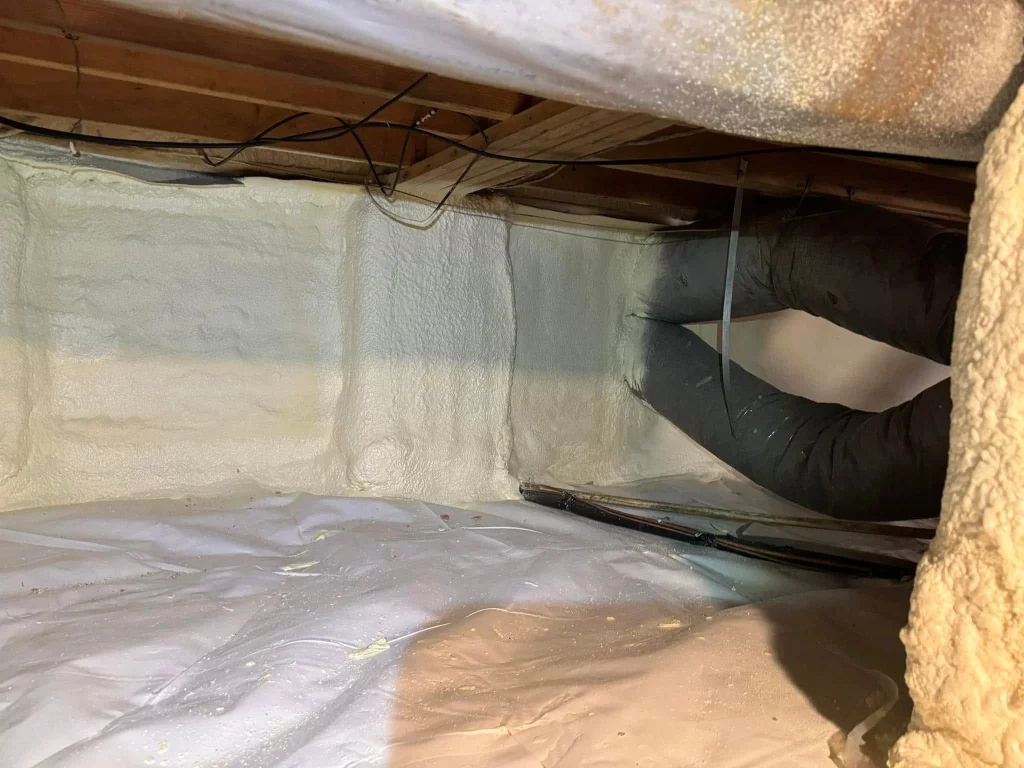
For homeowners in Troy, North Carolina, the right crawl space insulation depends on whether the space is vented or sealed, what the foundation walls are made of, and how moisture is being managed. In our experience working across the Piedmont region, closed-cell spray foam applied to the perimeter walls of a sealed crawl space delivers the strongest overall performance for Troy’s hot, humid climate. Rigid foam board is a solid alternative for certain wall types, while traditional fiberglass batts under the floor remain the weakest long-term option in a humid environment like Montgomery County. Homeowners can explore crawl space insulation services to determine the right approach for their property.
Troy is located in Montgomery County, squarely within North Carolina’s Piedmont region. This area falls into Climate Zone 4 on the International Energy Conservation Code map, which is classified as mixed-humid. Annual precipitation in the Piedmont ranges from 44 to 50 inches, and summers are consistently hot and humid with high dew points.
This matters for crawl spaces because the combination of warm outdoor air, high humidity, and cooler ground temperatures creates a condensation risk inside any vented crawl space. The DOE Building America Solution Center notes that in warm, humid climates, outside air drawn through foundation vents actually increases moisture levels rather than reducing them. When 90-degree, humid outdoor air enters a 65-degree crawl space, condensation forms on floor joists, ductwork, and foundation walls. That condensation leads directly to mold growth, wood rot, and degraded insulation.
The EPA’s mold prevention guidance confirms that the key to mold prevention is moisture control, and that water entry into crawl spaces should be actively managed, not ignored. For Troy homeowners, this means insulation decisions and moisture management are inseparable.
The single most important decision in Troy crawl spaces is not which insulation material to use, but whether to seal or vent the crawl space. Building science research has moved decisively toward sealed, conditioned crawl spaces in humid climates.
As Building Science Corporation explains in Info-512, crawl spaces should be designed and constructed as mini-basements. They should not be vented to the exterior. Instead, the ground should be vapor-sealed, walls insulated and air-sealed, and the space conditioned with indoor air. BSC notes that traditional vented crawl spaces are often damp, moldy, and inhabited by pests, and that they are almost universally connected to indoor air through unintentional leaks in floors and ductwork.
Joseph Lstiburek of BSC expands on this in BSI-115, stating that crawl spaces should either be completely connected to the house (conditioned) or completely disconnected from it (sealed as outside). When crawl spaces are connected to both the outside and the inside simultaneously, moisture and air quality problems follow. For Troy homeowners, the conditioned approach is the clear recommendation because our humidity levels make vented crawl spaces impractical for most of the year.
Once you have decided to seal and condition the crawl space, the next question is which insulation material to apply to the perimeter walls. Here is how the main options compare for Montgomery County homes:
| Insulation Type | Where It Goes | R-Value Per Inch | Moisture Resistance | Best Use in Troy Crawl Spaces |
|---|---|---|---|---|
| Closed-cell spray polyurethane foam | Perimeter walls and rim joist | ~6.0 to 7.0 per inch | Excellent (water-resistant, air seals) | Wall insulation in sealed crawl spaces, especially irregular or stone walls |
| Rigid foam board (XPS or polyiso) | Perimeter walls | 3.8 to 6.5 per inch (varies by type) | Very good (does not absorb water) | Smooth concrete or CMU walls where mechanical fastening is straightforward |
| Open-cell spray foam | Perimeter walls or rim joist | ~3.5 per inch | Poor (absorbs and holds water) | Not recommended for crawl space walls in humid climates |
| Fiberglass batts | Between floor joists (vented crawl spaces) | ~3.1 to 3.4 per inch | Very poor (sags, absorbs moisture) | Legacy applications only, not recommended for new work in humid zones |
Closed-cell spray polyurethane foam delivers the highest R-value per inch and also serves as a continuous air barrier and vapor retarder. When applied to crawl space walls, it conforms to irregular surfaces, seals gaps around penetrations, and bonds directly to concrete, block, and stone foundations. This makes it particularly well suited for older Troy homes where foundation walls may be uneven, have protrusions, or be constructed from fieldstone.
According to BSC’s Info-512, three inches of closed-cell medium-density spray foam achieves approximately R-18 and meets permeability requirements for crawl space wall insulation. The closed-cell structure means the foam itself does not absorb water, which is critical in Piedmont crawl spaces where moisture exposure is a constant concern.
Rigid foam board, specifically extruded polystyrene (XPS) or polyisocyanurate, is the other recommended option for crawl space walls. It is mechanically fastened to the interior perimeter of the foundation walls using masonry fasteners. Research recommends unfaced rigid foam board because it allows some breathability, which helps the wall assembly dry inward.
Rigid foam works best on concrete masonry unit (CMU) or poured concrete walls with relatively flat, even surfaces. For Climate Zone 4, two inches of XPS provides approximately R-10, meeting the North Carolina code minimum for crawl space wall insulation.
The traditional approach of insulating between floor joists over a vented crawl space has significant drawbacks in Troy’s climate. Fiberglass batts are air-permeable, meaning humid air passes right through them. When warm, moist outdoor air enters the crawl space through vents in summer, it condenses on the cool underside of the floor assembly. The fiberglass batts absorb and hold this moisture, which leads to mold growth on the wood framing, causes the batts to sag and fall out of place, and reduces their insulating effectiveness. Homeowners can learn more about crawl space insulation options for managing these moisture-related problems.
Industry fact sheets identify moisture control, airtight construction, and complete insulation coverage as the three keys to an effective crawl space system. Fiberglass between floor joists in a vented crawl space fails on all three counts in a humid Piedmont climate.
Troy falls within Climate Zone 4 per the North Carolina Energy Conservation Code. The North Carolina Building Code Council’s adopted requirements specify that crawl space walls must be insulated with either R-10 continuous insulation or R-13 cavity insulation when the crawl space is sealed. The code also mandates:
These requirements exist because building scientists and code officials have demonstrated that sealed crawl spaces with perimeter insulation, proper vapor barriers, and mechanical drying produce a crawl space that stays dry and stable.
| Home Type | Recommended Insulation Approach | Key Considerations |
|---|---|---|
| Newer homes with poured concrete or block walls | Closed-cell spray foam or rigid foam board on perimeter walls, sealed crawl space | Smooth walls make both options straightforward. Spray foam adds air sealing at the rim joist. |
| Older homes with stone or irregular foundation walls | Closed-cell spray foam on walls and rim joist, sealed crawl space | Rigid board cannot conform to uneven stone surfaces. Spray foam fills gaps and bonds directly. |
| Homes on a tight budget considering retrofit | Rigid foam board on walls with canned spray foam sealing seams and rim joist | Lower material cost than full spray foam application, but still requires careful air sealing. |
| Homes with existing vented crawl space and fiberglass | Remove fiberglass, seal vents, install wall insulation and vapor barrier | Do not leave fiberglass in place. It has likely absorbed moisture and may contain mold. |
| Flood-prone properties near the Pee Dee River basin | Consult with us about flood vent requirements and elevated strategies | Local codes may require flood vents. Insulation planning must account for this. |
Choosing the right contractor matters as much as choosing the right material. Here are signs that a contractor is qualified to handle your Troy crawl space insulation project:
Spray Foam Pro has extensive experience sealing and insulating crawl spaces across Montgomery County and the surrounding Piedmont region. We understand the specific challenges that Troy’s humid climate presents, from condensation management to code-compliant termite inspection gaps. Our team evaluates every crawl space individually before recommending a solution, because we know that no two foundations are identical.
Call us at (910) 606-6247, email [email protected], or fill out our online form to request a quote today.
Schedule a Crawl Space Assessment
In Troy’s humid climate, insulating and sealing the perimeter walls is the recommended approach. Insulating between floor joists in a vented crawl space creates condensation problems, while wall insulation in a sealed crawl space keeps the entire floor assembly warmer and drier.
Most sealed crawl spaces in Montgomery County need some form of moisture control. This can be conditioned air from your HVAC system, a standalone dehumidifier, or an exhaust fan, depending on your home’s setup. The building code requires a drying mechanism in all sealed crawl spaces.
North Carolina code requires a 3-inch bare strip between the top of the wall insulation and the sill plate for termite inspection. Our installers stop the spray foam application 3 inches below the sill plate, leaving the foundation wall visible for pest control inspections.
We do not recommend this. Fiberglass batts in a vented crawl space have likely been exposed to moisture for years and may harbor mold. Removing them and switching to perimeter wall insulation eliminates a moisture trap and improves air quality in your home.
A properly installed sealed crawl space includes perimeter drainage and a ground vapor barrier that directs water toward a sump or low point. Standing water should never be encapsulated. If your crawl space has active water intrusion, we address the drainage problem before any insulation goes in.