
Spray foam insulation has become one of the most effective tools for builders trying to meet increasingly demanding energy codes in 2026. With states adopting the 2024 International Energy Conservation Code (IECC), which the U.S. Department of Energy confirmed delivers approximately 7.8% greater site energy savings than the 2021 edition, builders face tighter air leakage requirements, higher performance expectations, and more complex compliance pathways. Spray foam directly addresses these challenges because it combines high R-value thermal performance with built-in air sealing in a single application, something traditional insulation materials cannot match on their own. Whether you are building in a mild Climate Zone 2 or a harsh Climate Zone 7, the right spray foam strategy, closed-cell, open-cell, or a hybrid approach, can simplify code compliance while improving overall building performance. This is why many contractors choose an experienced spray foam partner for builders in Troy, NC, when navigating modern energy-efficiency standards and construction timelines.
The 2024 IECC represents more than an incremental tweak. The code tightened building envelope air leakage requirements, updated fenestration standards in colder climate zones, and introduced an entirely new compliance framework. According to the DOE’s Federal Register determination, residential buildings meeting the 2024 IECC will see 6.8% source energy savings and 6.6% energy cost savings compared to the 2021 edition. These stricter standards are one reason builders increasingly rely on spray foam solutions for Troy builders.
For builders, the practical impact is clear: your building envelope needs to perform better, and the methods you used five years ago may no longer be enough. Blower door testing thresholds are stricter, wall and ceiling R-value expectations have shifted, and the new R408 Additional Efficiency Requirements section demands you earn at least 10 credits from a minimum of two efficiency measures.
Spray polyurethane foam (SPF) is unique among insulation materials because it handles four critical building science functions simultaneously: water control, air control, vapor control, and thermal control. As the Building Science Corporation’s Residential Spray Foam Guide explains, “spray foam is unique in that it can handle all four’ control layers, and using it results in ‘low exterior air leakage that provides significant energy efficiency.”
This matters for code compliance because the 2024 IECC requires builders to address thermal resistance and air tightness as separate but related performance metrics. With fiberglass or cellulose, you need separate materials for insulation, air barriers, and vapor control. Spray foam handles all three in one application, reducing installation complexity and the risk of gaps or misalignment between systems.
| Property | Closed-Cell SPF | Open-Cell SPF |
|---|---|---|
| R-Value per Inch | R-6 to R-7 | R-3.5 to R-3.8 |
| Air Barrier | Yes (at minimum thickness) | Yes (at minimum thickness) |
| Vapor Retarder | Class II at 1.5 inches | No (requires a separate vapor retarder in cold climates) |
| Best Applications | Walls with limited depth, foundations, crawlspaces, and cold climates | Walls in warm/mixed climates, unvented attics in zones 1-4 |
| Moisture Resistance | High (resists liquid water) | Low (vapor open) |
| Climate Zone Suitability | All zones, especially 5-8 | Zones 1-4, zone 5 with vapor retarder |
The 2024 IECC tightened air leakage testing requirements. Reduced air leakage is now one of the most direct ways to earn credits under Section R408.2.1.4. Spray foam inherently creates an airtight building envelope because it expands to fill gaps, cracks, and penetrations that would otherwise allow unwanted air infiltration.
The U.S. Department of Energy’s insulation and air-sealing guidance identifies spray foam as an effective solution for sealing rim joists, wall penetrations, and other high-leakage areas. For builders struggling to hit the tighter ACH50 targets in the 2024 IECC, spray foam applied at key transition points can dramatically reduce blower door test results without requiring additional air barrier materials.
ENERGY STAR’s recommended insulation levels, based on the 2021 IECC Table R402.1.3, show that ceiling insulation requirements range from R-30 in Zone 1 to R-60 in Zones 4-8. Wall requirements range from R-13 in Zone 2 up to R-20 plus R-5 continuous insulation in Zones 4-8.
Closed-cell spray foam’s high R-value per inch (up to R-7) makes it possible to meet these requirements even in constrained spaces. A 2×6 wall cavity filled with closed-cell spray foam can achieve approximately R-33 to R-38.5, exceeding the prescriptive R-20 cavity requirement with room to spare. This is especially useful when dealing with raised heel truss requirements for full-depth ceiling insulation, which many 2026 jurisdictions now enforce.
The Building Science Corporation guide notes that in IECC Climate Zones 6 and higher, high-density closed-cell spray foam “provides additional condensation control and will qualify as Class II vapor retarder at 1.5 inches.” For builders in Zones 5-8, this means closed-cell spray foam can satisfy both the thermal and vapor control requirements of the IRC (Section R702.7) without adding a separate vapor barrier. Open-cell spray foam can still be used in these zones, but requires an interior vapor retarder to manage condensation risk.
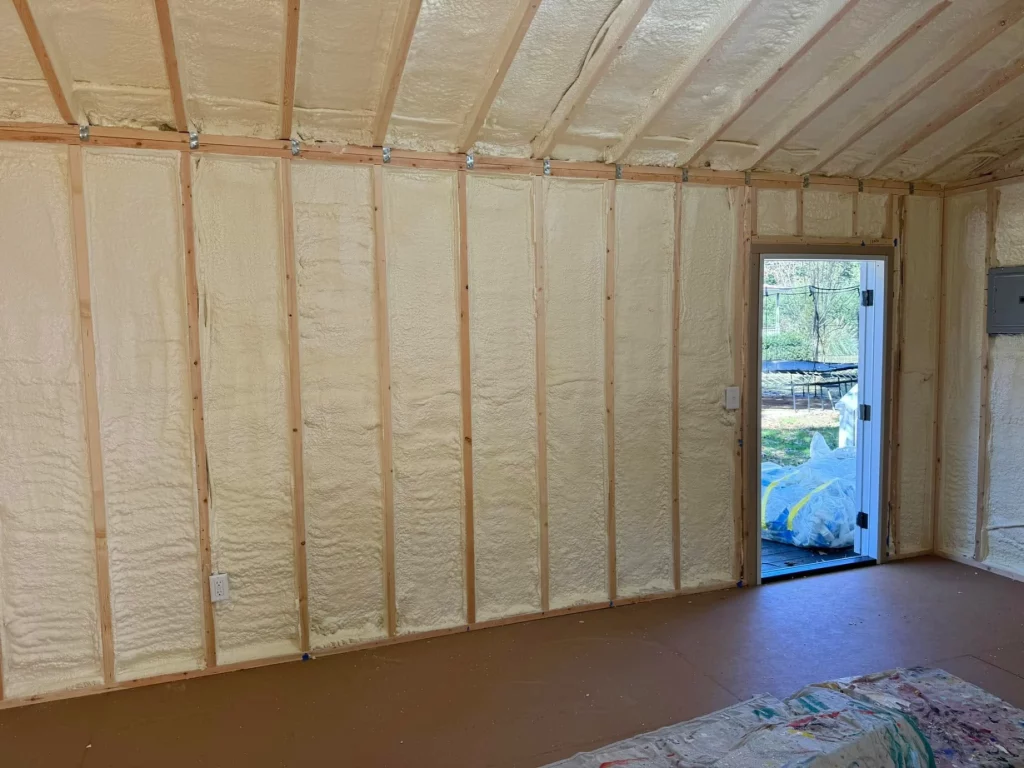
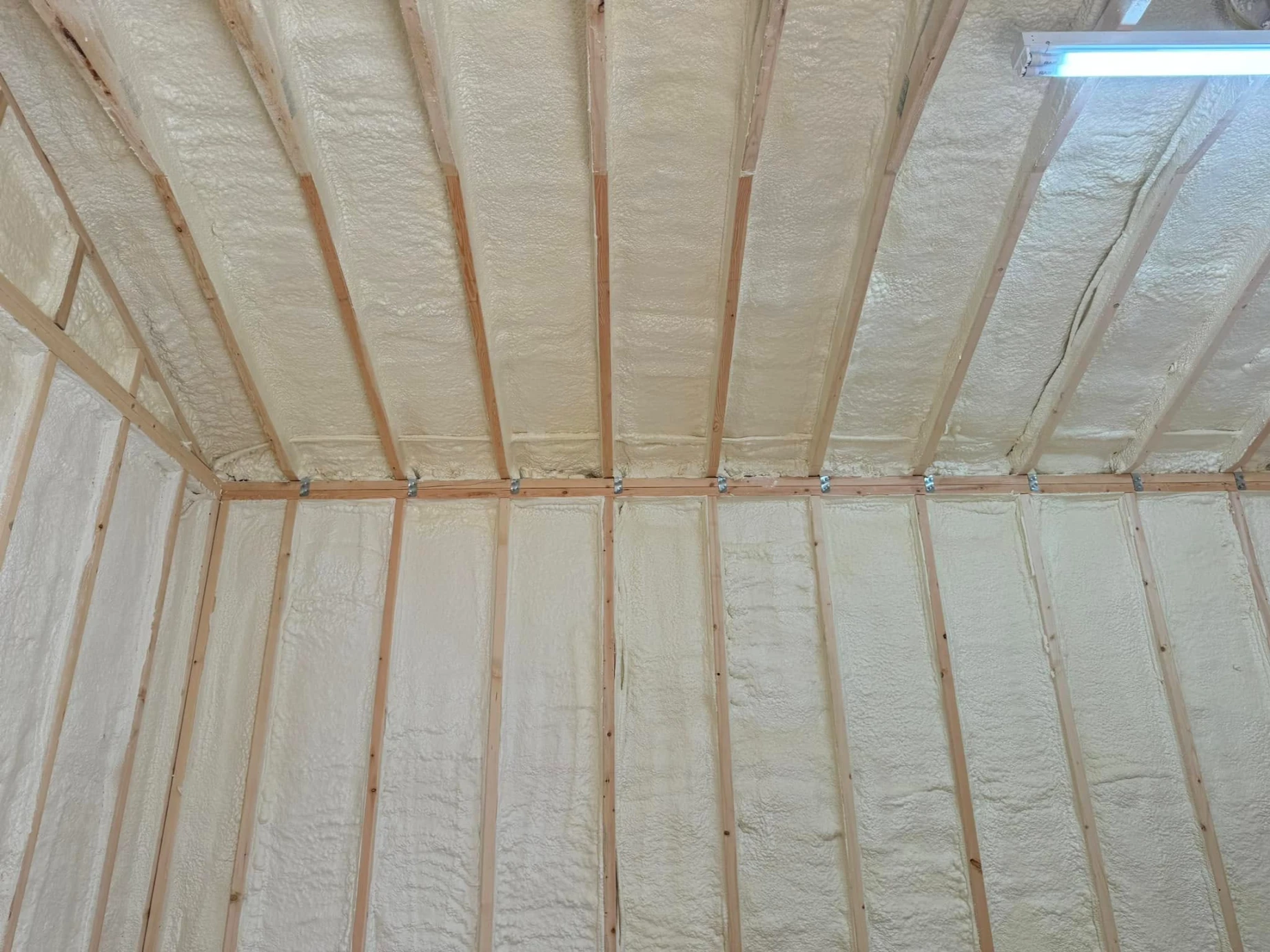
For standard 2×4 or 2×6 wood-frame walls, builders have several spray foam options. Full cavity fill with open-cell or closed-cell foam works in most climates. Hybrid walls are also effective, where a thin layer of closed-cell spray foam is applied to the interior sheathing surface (providing air sealing, vapor control, and partial R-value), and the remaining cavity is filled with fiberglass or cellulose. The IRC specifies minimum closed-cell foam thickness for condensation control based on climate zone and framing depth.
Unvented conditioned attics are a common spray foam application, especially in warm climates where ductwork runs through the attic space. The Building Science Corporation guide confirms that both open-cell and closed-cell spray foam can be applied directly to the underside of the roof deck. In Zones 5 and higher, closed-cell is required for condensation control. Hybrid approaches using a layer of closed-cell foam topped with open-cell or fibrous insulation also work well.
For vented attics, closed-cell spray foam excels at creating an airtight seal at the ceiling plane, forming what the guide describes as an airtight “bathtub” that is then filled with fibrous insulation. This approach addresses the 2024 IECC’s emphasis on continuous air barriers at the thermal envelope.
Spray foam applied directly to interior concrete foundation walls and under basement slabs provides both insulation and moisture control. The Building Science Corporation recommends high-density closed-cell foam for interior foundation walls in Zone 5 and higher, and notes it should only be used under slabs over a granular capillary break. Conditioned crawlspaces insulated with closed-cell spray foam function as “mini basements,” contributing to overall envelope performance.
| Builder Type | Recommended Approach | Key Benefits |
|---|---|---|
| Production Builders (warm climates, Zones 1-3) | Open-cell SPF in walls and attic roof decks | Lower material cost, adequate R-value for milder climates, built-in air sealing |
| Custom Builders (mixed/cold climates, Zones 4-6) | Hybrid: closed-cell SPF on sheathing + fibrous cavity fill | Condensation control, code-compliant vapor retarder, cost-efficient thermal performance |
| High-Performance Builders (Zones 6-8) | Full closed-cell SPF in walls, roof deck, and foundations | Maximum R-value per inch, integrated vapor control, and the tightest air sealing |
| Remodelers/Retrofit | Closed-cell SPF in rim joists, wall cavities (drill-and-fill), and attic transitions | Addresses the highest-leakage areas first, with minimal demolition required |
You know your spray foam approach is working when blower door tests consistently come in below the 2024 IECC’s mandatory air leakage thresholds, your REScheck or performance path modeling shows comfortable compliance margins, and your HERS rater confirms the envelope performs as designed. The right spray foam installer will provide coverage verification, thermal imaging of completed areas, and clear documentation that aligns with your chosen compliance pathway. Look for installers who understand the differences between the prescriptive, performance, and ERI paths and can tailor foam type and thickness accordingly.
Meeting the 2024 IECC is not optional, and the states are moving fast to adopt it. Our team at Spray Foam Pro specializes in helping builders across residential and commercial projects achieve code compliance through properly specified and expertly installed spray foam insulation. Whether you need closed-cell foam for a tight wall assembly or a full envelope solution for a custom home, we have the experience to get it done right the first time.
Request a Quote or call us at (910) 606-6247 to discuss your project. You can also schedule a Code Compliance Consultation to review your plans and determine the most effective spray foam strategy before you build. Our crew is ready to help you pass inspection and deliver a high-performance building every time.
No, the 2024 IECC does not mandate spray foam specifically. However, its tighter air leakage requirements and higher performance expectations make spray foam one of the most efficient ways to achieve compliance, because it combines insulation and air sealing in a single material.
As of mid-2026, only a few jurisdictions have formally adopted the 2024 IECC, including Illinois (with amendments), Nevada, and Rhode Island. The DOE determination requires all states to certify their review by December 30, 2026, so adoption is accelerating rapidly.
Open-cell spray foam can be used in cold climates but typically requires a separate interior vapor retarder to manage condensation risk. The IRC specifies minimum requirements for vapor control in Climate Zones 5-8. Closed-cell foam is generally preferred in these zones because it acts as both an air barrier and a vapor retarder.
The 2024 IECC Section R408 requires builders to earn at least 10 credits from efficiency measures. Reduced air leakage (Section R408.2.1.4) is one of the most accessible credits, and spray foam’s inherent air-sealing properties make it straightforward to achieve. Your HERS rater can model the exact credit value based on your blower door test results.
Yes. Spray foam works with the prescriptive path (meeting R-value and air leakage requirements directly), the simulated performance path (reducing total energy use through envelope improvements), and the Energy Rating Index (ERI) path (lowering the home’s ERI score through superior envelope performance).